NEAR Intents is not another bridge. It is a fundamentally different architecture for cross-chain value transfer — one that eliminates bridge risk, achieves near-instant settlement, and routes transactions through a confidential compute environment where they are invisible to on-chain surveillance.
The Problem with Traditional Bridges
Lock-and-mint bridges — the dominant cross-chain primitive — have a structural vulnerability: they concentrate assets in smart contracts. To move ETH from Ethereum to another chain, a bridge locks your ETH in a contract and mints a wrapped version elsewhere. That locked ETH pool is a target. The history is brutal: over $2.5 billion lost to bridge hacks.
Beyond security, bridges are slow. Most require 10+ block confirmations on the source chain before releasing funds on the destination, leading to 15–45 minute settlement times.
How NEAR Intents Works
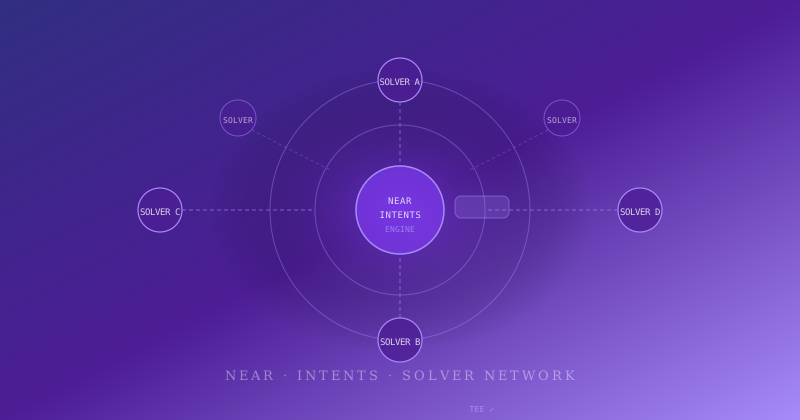
NEAR Intents replaces the lock-and-mint model with an intent-based solver network. Here is the architecture:
1. Intent Declaration
Instead of "move my ETH to Polygon," you declare an intent: "I want to swap X ETH for Y USDC on any chain." The intent is a signed message specifying the desired input and output — not a specific route or protocol.
2. Solver Competition
A network of solvers — professional market makers with pre-positioned liquidity across chains — compete to fill your intent at the best rate. Each solver submits a bid. The best bid wins and fills the order.
This is important: solvers already hold liquidity on both chains. They do not need to bridge anything. They fulfill your order from existing inventory and settle with each other off-chain.
3. Confidential Settlement
The matching and settlement happens inside NEAR's confidential execution environment. The trade inputs, amounts, and counterparty information are processed inside a trusted execution environment (TEE) — a hardware-isolated compute environment where not even NEAR's validators can observe the plaintext transaction data.
What ends up on-chain is only the settlement proof — not the swap details.
4. Delivery
The winning solver delivers the output tokens to your receiving address on the destination chain. From your perspective: you sent ETH, you received BTC (or USDC, or any supported token). The cross-chain complexity is invisible.
Why This Is Faster Than Bridges
Traditional bridges wait for block finality on the source chain before acting. NEAR Intents settlement happens in parallel with chain confirmation — solvers take on the finality risk in exchange for the spread. This is why NEAR Intents typically settles in 5–10 minutes even for BTC-involved swaps (where Bitcoin's 6-confirmation requirement takes ~60 minutes in traditional bridges).
The Privacy Advantage
For a surveillance firm trying to trace your swap:
- Traditional DEX swap: Your wallet address, input amount, output amount, and timestamp are all on-chain in the same block
- Traditional bridge: Your address is linked across two chains with a clear trail
- NEAR Intents: Only the settlement proof is on-chain. The solver sees your amounts but not your final receiving address. The TEE means no third party sees the full picture
This is structural privacy — not a mixer or obfuscation layer applied on top, but a protocol that never exposes your full swap data to any single party.
Where NEAR Intents Is Best
NEAR Intents is GhostUSD's most-selected route for good reason. It wins on:
- Rate: Solver competition drives rates to near-market rates with minimal spread
- Speed: 5–10 minutes for most pairs, faster than any bridge-based route
- Privacy: Confidential settlement with no full on-chain trace
- Token breadth: Supports 100+ tokens across Bitcoin, Ethereum, Solana, NEAR, and more
It is not always the winner. For very large amounts or less liquid pairs, HoudiniSwap or RocketX may offer better rates. That is exactly why GhostUSD queries all three simultaneously and lets you compare.
The Risks and Limitations
No protocol is perfect:
- Solver centralization risk: If solver competition is low for a pair, rates can be worse. NEAR Intents is still maturing its solver network for some token pairs.
- NEAR dependency: The matching layer runs on NEAR. An outage in NEAR's network affects NEAR Intents availability.
- Minimum amounts: Solver economics require minimum swap sizes (typically $10–25) to be worth filling.
The Bigger Picture
NEAR Intents represents a shift in how cross-chain infrastructure thinks about privacy: not as a bolt-on feature (a privacy coin, a mixer, an obfuscation layer) but as a property of the core settlement mechanism. When the protocol itself is private by design, users benefit automatically without needing to take extra steps.
This is the direction the industry needs to go — and GhostUSD is routing you through it by default.