Every transaction you make on a public blockchain — Ethereum, Bitcoin, Solana — is stored forever in a public ledger. This is the double-edged sword of decentralization: no central party controls the chain, but anyone can see every move you make.
The Surveillance Economy on the Blockchain
Companies like Chainalysis, Elliptic, and TRM Labs have built multi-hundred-million-dollar businesses doing one thing: tracking your crypto. They cluster wallet addresses, link them to real identities through exchange KYC data, and sell this intelligence to governments, financial institutions, and employers.
In 2024, the U.S. Department of Justice spent over $100 million on blockchain analytics contracts. The EU's Markets in Crypto-Assets (MiCA) regulation now requires exchanges to report suspicious transactions. This data does not stay inside those systems — it flows downstream.
- Employers run wallet checks before hiring in crypto-adjacent roles
- Insurance companies in some jurisdictions are beginning to factor crypto holdings into risk assessments
- Exchanges can freeze accounts or apply enhanced due diligence based on on-chain history
- Tax authorities across 40+ countries now receive automatic reports from exchanges (CARF)
What "Public" Really Means
Most people think of blockchain privacy the way they think of cash: anonymous. In reality, Bitcoin and Ethereum are pseudonymous at best. Once one address is tied to your identity — through an exchange withdrawal, an NFT purchase with a linked ENS name, or even a public Ethereum tip — every transaction linked to that address becomes deanonymized retroactively.
"Pseudonymity is not anonymity. It is anonymity with a time bomb attached."
The average user connects their wallet to dozens of dApps, bridges, and exchanges, each creating new data points. Analytics tools reconstruct the complete graph automatically.
Why Swaps Are the Most Exposed Action
When you swap ETH for USDC on Uniswap, three things happen simultaneously that surveillance firms love:
- Your wallet address is permanently associated with the trade
- The exact amount, timestamp, and output token are logged forever
- If the swap is large enough, analytics firms flag it and begin building a profile
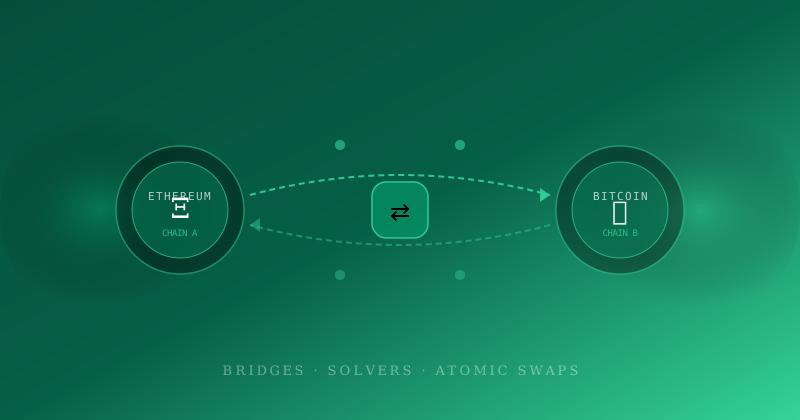
Cross-chain swaps are even worse. A bridge transaction creates a visible link between your address on Chain A and your address on Chain B — connecting two previously separate identity graphs.
The Right to Financial Privacy
Privacy is not the same as secrecy. You do not need to be doing anything wrong to deserve privacy in your financial life. Consider:
- You do not announce your bank balance to strangers
- You do not broadcast your salary when paying for coffee
- You do not want your employer to see how much you paid for medical care
These are the same principles applied to crypto. Financial privacy is a fundamental human right recognized in UDHR Article 12 and enforced in most democracies through banking secrecy laws — laws that do not yet fully apply to public blockchains.
What Privacy Swaps Actually Do
Privacy-preserving swap protocols break the on-chain link between input and output. Instead of a direct wallet-to-wallet swap visible on one chain, the transaction is routed through:
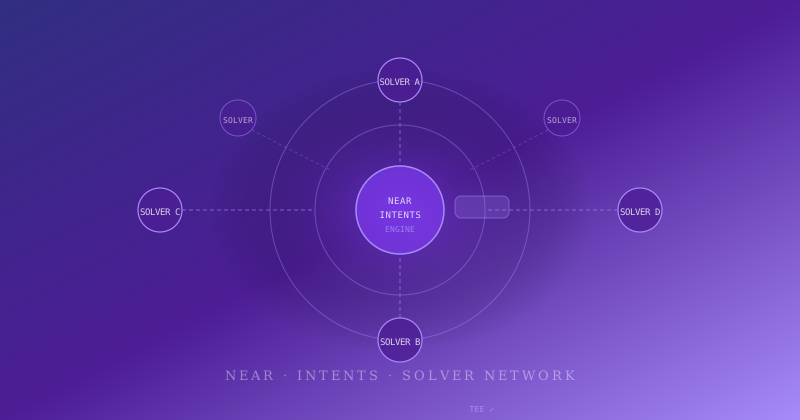
- Confidential compute layers (like NEAR Intents) that process swaps off the public transaction log
- Mixer-style protocols that pool deposits before distributing outputs
- Cross-chain routing that makes tracing across chains computationally expensive
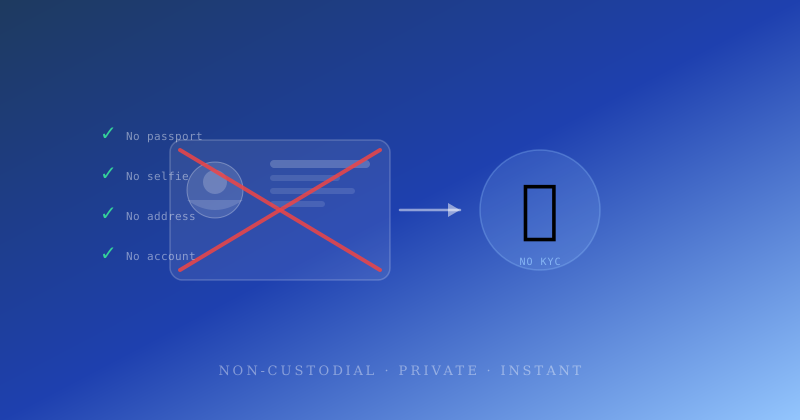
GhostUSD aggregates these approaches, letting you choose the swap that balances privacy, speed, and rate — all without a single piece of KYC data leaving your device.
What You Can Do Right Now
You do not need to wait for regulation to catch up. Here is a practical hierarchy of privacy actions for crypto users:
- Use a privacy-first swap aggregator like GhostUSD for every swap, not just the "sensitive" ones — patterns matter as much as individual transactions
- Never reuse addresses — generate a new address for each interaction when possible
- Avoid linking ENS/labels to high-value wallets — public names are permanent deanonymization anchors
- Prefer fixed-rate swaps — floating rate transactions leave a more precise fingerprint (exact amounts match more easily)
- Use a refund address on a different wallet — this breaks the direct trail if a swap fails and refunds
The Bottom Line
The blockchain surveillance industry is growing faster than the privacy tooling designed to counter it. But the tools exist. Privacy swaps are no longer experimental — they are fast, affordable, and accessible without any KYC. The only barrier is knowing they exist.
That is what GhostUSD is built for.